Lit Circle #3: Share TED Talk info from H/W. What was your talk about? What insights or questions do you have? What connections/further reading have you found?
With a partner, look at the Research Rubricand see where you would place yourself for 'questioning and investigating' and 'analysis of evidence'.
Summative Task Proposal/Research portfolio (in drop)
What ideas do you have about lessons that sport teaches us about life?
Review feedback/video from the formative and set improvement goals for the summative task.
Begin preparing for your summative task (research portfolio).
H/W- ‘What I talk about…’ Read chapters 8-9. Reader’s Journal- Choose one of Murakami’s lessons that you think you could learn from. Write a detailed reflection explaining how this lesson could be applied to your own life.
Today you will give your 2 min presentation on cheating in sport. I will give you feedback on the rubric below.
Exemplary
Meets
Approaches
Area of Concern
Claim & Development
Presents information, findings and supporting evidence, using a distinct, compelling and/or memorable perspective,
such that listeners can follow the line of reasoning; alternative or opposing perspectives are anticipated, addressed and countered
Presents information, findings and supporting evidence, conveying a distinct perspective, such that listeners can follow the line of reasoning; alternative or opposing perspectives are addressed
Presents information, findings and supporting evidence, clearly, concisely and logically, such that listeners can follow the line of reasoning
Presents information, findings and supporting evidence, but is not clear, concise, and/or logical - hard for the listeners to follow the line of reasoning.
Organization
Organizational structure includes an effective introduction and thought-provoking conclusion; sequences ideas strategically; uses subtle transitions to link sections
Organizational structure includes an effective introduction and conclusion; logical sequencing of ideas with a line of reasoning that is easy to follow; transitions to link sections
Organization structure includes an introduction and conclusion; sequencing of ideas is difficult at times to follow; transitions missing or formulaic.
Attempts a structure and organization to support the position. Organizational structure may be missing an introduction and/or conclusion; ideas hard to follow; no transitions between points.
Style & Delivery
Subtle, sophisticated confident/charismatic delivery that is clearly articulated with variation in pitch, tone, volume; maintains eye contact and avoids reading from notes; uses pauses, emphasis, facial expressions, gestures as appropriate and for effect and avoids distracting behaviors; shows appropriate use of conventions (e.g. avoids verbalized pauses)
Delivery is clearly articulated, demonstrating a variation in pitch, tone, volume; maintains eye contact; avoids reading from notes; uses pauses, emphasis, facial expressions, gestures as appropriate and for effect; and avoids distracting behaviors; shows appropriate use of conventions (e.g. avoids verbalized pauses)
Delivery attempts a clear articulation and variation in pitch, tone, volume; does not maintain eye contact and/or reads too much from notes; attempts to use pauses, emphasis, facial expressions, gestures, but not appropriately for effect; demonstrates some distracting behaviors; attempts appropriate use of conventions, but has some verbalized pauses
Delivery lacksawareness of/does not attempt to use delivery strategies; lacks articulation and variation in pitch, tone, volume; no eye contact due to reading from notes; no pauses, emphasis, facial expressions, gestures; distracting behaviors; excessive verbalized pauses
Summative Task:
You will create a TED Talk around the theme of what sport teaches us about life. You may build upon one or more of the ideas we discuss in class or suggest your own idea. It is your responsibility to formulate a question/topic for your talk and present a 3-5 minute speech about it.
Presentations will be due 15th/17th of March.
TED Talks are about ‘ideas worth spreading’ so your presentation should focus on a new idea or present an interesting angle on an old idea. You will research your topic in detail (recording your sources using Flipboard or in a research portfolio). You have a large amount of creative freedom in your presentation, but you must include some type of visual aid/presentation tool (Prezi, Keynote, PowerPoint, etc). Your visual aid is meant to enhance audience understanding of your ideas and add interest for the audience.
You will be assessed during your TED Talk for:
A compelling argument/thesis
Showing both your arguments and a counterargument
Effective introduction, transitions, and thought-provoking conclusion
Delivery should be confident, use vocalization and nonverbals
H/W: What I talk about…’ Chapter 5-7. Reader’s journal- Identify one idea that you could research further (e.g. mind/body connection-use of visualisation). Find a TED talk (or another type of speech) that explores the idea further. Using your research skills, provide a summary of talk and provide your insights.
During this unit, we are going to work on our research skills. Let's take a look at the Research Rubric. I am looking for you to demonstrate these skills both in your Reader's Journal and your formative/summative presentations. Lit circle #2 Continue to discuss examples of motivation and life lessons that Murakami discusses in these chapters (10mins)
Create a class magazine about cheating in sport. 1) Go to Flipboard and create an account. 2) Follow our Cheating in Sport magazine. 3) Download the 'Flip It' extension for Chrome (in web store). 4) Add your article about cheating in to sport to our magazine. This link will allow you to contribute to the magazine. 5) Provide a short summary and the insights this article provides about the motivations behind cheating in the 'Caption' section.
Lit circle #1- In your groups, share life lessons and examples of motivation from 'What I talk about when I talk about running'. (20mins)
After your discussion, write down one idea that really sticks with you/sparks your interest. What would you research to substantiate that idea? Record your ideas in your Reader's Journal.
Intrinsic vs Extrinsic motivation
Connection to passage on pg. 34-35: “I never disliked long distance running…I was able to smoothly incorporate running into my daily life”
Human motivation is complex. There are many reason why people choose to behave in certain ways. Sport tends to highlight human behavior and motivation at its best and worst. We often look to athletes and sporting teams to teach us lessons about the value of hard work, discipline and sacrifice but what happens when the desire to win leads to negative behaviors like cheating? From match-fixing and betting scandals to performance enhancing drugs and blood doping, cheating is synonymous with professional sports.
Match-fixing in tennis: Novak Djokovic tells of being offered $200,000 to fix a match
H/W- 1) Find an article about an incident of cheating in sport that gives some insight into the motivation behind the cheating. Bring the link to class. 2) Read chapters 3-4 of ‘What I talk about…’ In your Reader’s Journal, continue to find examples of motivation/life lessons that Murakami discusses.
In this unit, we will be exploring the life lessons that people receive from sport. Our class novel, ‘What I talk about when I talk about running’ by Haruki Murakami, will guide our discussions around the role of competition, the mind/body connection, intrinsic vs extrinsic motivation, goal setting and pushing limits. During this unit you will be assessed on your Presentation skills (20% of semester grade), and your Research/Reading skills (10% of semester grade).
As you watch this video, think about the lessons that sport teaches about motivation. How can these lessons be applied to other pursuits in life? Generate a list of ideas about this with your table group.
Summative Task:
You will create a TED Talk around the theme of what sport teaches us about life. You may build upon one or more of the ideas we discuss in class or suggest your own idea. It is your responsibility to formulate a question/topic for your talk and present a 3-5 minute speech about it.
Presentations will be due 15th/17th of March.
TED Talks are about ‘ideas worth spreading’ so your presentation should focus on a new idea or present an interesting angle on an old idea. You will research your topic in detail (recording your sources using Flipboard or in a research portfolio). You have a large amount of creative freedom in your presentation, but you must include some type of visual aid/presentation tool (Prezi, Keynote, PowerPoint, etc). Your visual aid is meant to enhance audience understanding of your ideas and add interest for the audience.
You will be assessed during your TED Talk for:
A compelling argument/thesis
Showing both your arguments and a counterargument
Effective introduction, transitions, and thought-provoking conclusion
Delivery should be confident, use vocalization and nonverbals
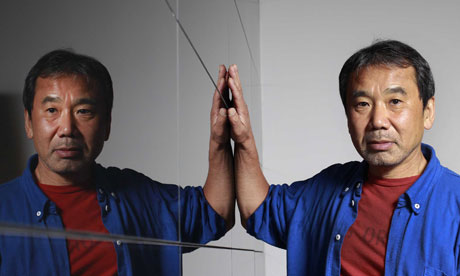
Haruki Murakami is a contemporary Japanese author. His novels and short stories have won awards worldwide and have been translated into 50 languages. He is also a serious marathon runner and triathlon enthusiast. He began running at age 33. Over the last 20 years, he has run at least one marathon per year, including an ultramarathon (100k).
As we read this book, we will look for ideas related to two things: life lessons and motivation. Let's begin by reading the forward together as a class.
H/W- Read Chapters 1 & 2 and complete the Reader's Journal (in drop). Please bring a PRINTED copy of your reader's journal for next class.
Your responses in the Reader's Journal and your contributions to Lit Circle discussions will be graded using the Research Rubric and added to the your Research/Reading skills (10% of semester grade).
Today is a work day for your Summative task. It is due on the 10th of Feb. It will be assessed using the Informative Rubric.
What makes people great? Create a photojournalism piece covering a person or group of people at SAS. You should choose a person or persons you feel have an interesting story and good personal characteristics, and then uncover what makes them great. You want to get at experiences, but you should also embed facts. Do a brief video where you do voiceovers and include them telling their stories (3 minutes max) or photojournalistic essay (5 pages max double-spaced with images) about that person which can be published on the “Morning Show” or for the EYE. Think Humans of SAS or a sports journalism piece with a more informative twist. The informative writing or video should demonstrate the characteristics of your subject, and information about the experiences that generate these characteristics.
I will conference with you today about your FOCUS & EVIDENCE